


The malice definition is a desire or intention to harm another person, often connected with ill will, hostility, or spite. In everyday English, it describes harmful intent rather than ordinary anger. In legal settings, the term can have a narrower meaning that depends on the type of case and the jurisdiction. Our guide to Conjugal Meaning Explained covers this in more detail.
| Quick fact | Meaning |
| Part of speech | Noun |
| Pronunciation | MAL-iss |
| Plain-English meaning | A wish or intention to cause harm or distress |
| Related adjective | Malicious |
| Related adverb | Maliciously |
| Common related ideas | Ill will, hostility, spite, harmful intent |
| Legal use | A mental-state concept whose meaning changes by legal context |
Malice Definition in Plain English

The simplest way to understand the word is to focus on intent. Someone who acts with harmful intent wants another person to suffer, lose something, feel distressed, or experience some other form of injury.
That makes the word stronger than ordinary irritation. You can be angry with someone without wanting anything bad to happen to them. Anger describes an emotion, while this word often points to the motive behind an action.
Imagine two coworkers arguing over a mistake. One criticizes the other because the problem needs fixing. The second spreads a false rumor afterward to damage his coworker’s reputation. The motives behind those actions are quite different.
How It Differs From Anger, Spite, Hatred, and Ill Will
Several words describe negative feelings, but they aren’t exact substitutes.
| Word | Main idea | Harm intended? | Typical use |
| Anger | Strong displeasure | Not necessarily | An immediate emotional reaction |
| Spite | A wish to hurt or annoy | Often | Petty or retaliatory behavior |
| Hatred | Intense dislike | Not necessarily | Strong, lasting negative feeling |
| Ill will | Hostile or unfriendly feeling | Sometimes | General resentment or hostility |
| Malevolence | A wish to cause harm | Usually | Strong or persistent harmful intent |
The main question is whether the person merely feels negatively or wants harm to occur. That distinction often tells you which word fits best.
Spite, for example, often suggests retaliation over a personal grievance. Hatred describes intense dislike but doesn’t always involve action. Ill will is broader and may exist without a plan to hurt anyone.
7 Examples of Malice in a Sentence
These examples show how the word can describe different kinds of harmful intent.
- She corrected his mistake firmly but without malice.
- Investigators believed the property had been damaged out of malice.
- His criticism was direct, but there was no malice behind it.
- The message was written with malice and was intended to embarrass its recipient.
- Even after the argument, she bore no malice toward her former colleague.
- The rumor appeared to have been spread with malice rather than carelessness.
- A harmless joke can become malice when its purpose is to humiliate someone.
The situations differ, but the central idea remains the same. The speaker is describing a motive, not simply an unpleasant result.
A person can also cause harm accidentally. An accident, careless statement, or poor decision doesn’t automatically show harmful intent. Context matters.
Synonyms and Antonyms
Common synonyms include spite, ill will, hostility, malevolence, animosity, and hatred. Each carries a slightly different shade of meaning.
Spite often sounds personal and retaliatory. Malevolence suggests a stronger or more persistent desire to cause harm. Animosity refers to strong hostility between people or groups.
Possible antonyms include goodwill, unkindness, malevolence, hostility, and compassion. The best opposite depends on the sentence.
For example, goodwill works well when you’re contrasting hostile and friendly intentions. Compassion fits better when the contrast involves concern for another person’s suffering.
Readers interested in vocabulary, language, and learning resources can explore more topics in Publishie’s Education section.
Related Word Forms and Origin
The adjective malicious describes an action, statement, or person associated with an intention to cause harm. The adverb maliciously describes the way an action is carried out.
For example, you might call a deliberately damaging rumor malicious. You could also say someone maliciously altered information if the change was intended to cause damage.
The noun has been used in English for centuries and developed from earlier French and Latin forms associated with badness or harmful intent. Knowing the word family makes it easier to recognize related forms while reading.
What Malice Means in Law
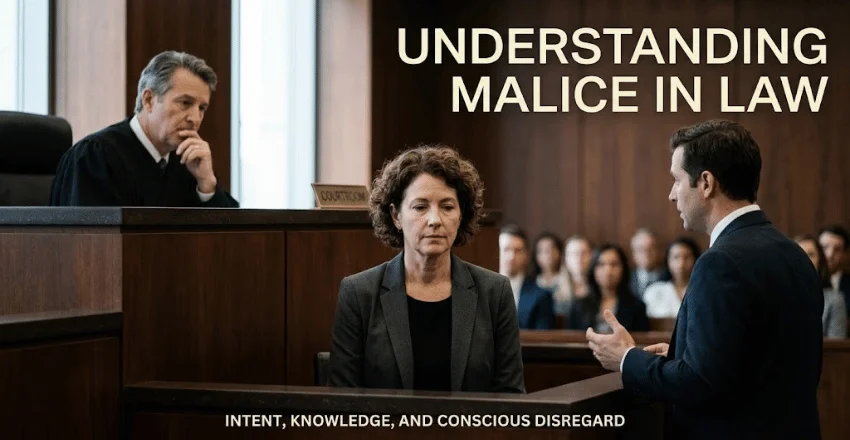
Legal writing can use familiar words in more technical ways. The exact meaning depends on the area of law, the legal test being applied, and the jurisdiction. Also worth reading: Drug Possession Lawyer.
In criminal law, the term can refer to a state of mind connected with intentionally committing a wrongful act without legal justification or excuse. It doesn’t always require proof of personal hatred toward a specific person.
That difference matters. Everyday conversation may focus on hostility or spite, while a court may focus more closely on what a person knew, intended, or consciously disregarded.
For more general explanations of legal topics, visit Publishie’s Law section.
Actual Malice in Defamation Cases
Actual malice is a specialized phrase in U.S. defamation law. It doesn’t simply mean that a speaker disliked the person being discussed.
In cases where the standard applies, the issue centers on whether a false statement was made with knowledge that it was false or with reckless disregard for whether it was true.
That is a much narrower test than ordinary hostility. A rude statement and a legally significant false statement aren’t automatically the same thing.
Anyone dealing with a real defamation dispute should seek legal advice for the relevant jurisdiction. Definitions, procedures, and standards can depend on the facts of the case.
Malice Aforethought in Criminal Law

The phrase malice aforethought comes from traditional criminal law and is associated with the mental element historically required for murder.
The phrase can be misleading to modern readers. “Aforethought” doesn’t always mean that someone spent days or weeks planning an act in advance.
Its legal meaning has developed through criminal law doctrine and can cover particular states of mind defined by the applicable law. Modern criminal statutes can also use different terminology.
Because criminal-law definitions vary, a dictionary explanation shouldn’t be used to decide whether a particular person or act satisfies a legal standard.
If you’re reading legal material because of a real dispute, understanding terminology is only the first step. Publishie’s guide on choosing the right personal injury attorney in Nevada also explains why relevant experience and jurisdiction matter when selecting legal help.
The Key Point to Remember
Think about intention, not simply anger.
Use the word when you want to describe a genuine wish to hurt, distress, humiliate, or otherwise harm another person. If you’re describing ordinary frustration, disagreement, or dislike, a less severe word may be more accurate.
Legal uses require extra care because courts and statutes can give familiar terms specialized meanings. For everyday vocabulary questions, start with the motive behind the behavior and then choose the word that best matches it.
Frequently Asked Questions
It means a desire or intention to cause harm, pain, distress, or another negative result. The word usually points to harmful intent rather than ordinary irritation or disagreement.
No. Hatred is intense dislike. A person can strongly dislike someone without planning or wishing to cause harm.
The two ideas can overlap, but the words emphasize different things. One focuses more on hostility, while the other can describe an intense emotional response.
It means you don’t continue to hold hostile or resentful feelings toward someone. People often use the phrase after an argument or disagreement to show that they aren’t seeking revenge.
The adjective is malicious. It describes behavior, words, or actions intended to cause harm.
For example, deliberately spreading a damaging false rumor may be described as malicious behavior.
No. It appears frequently in ordinary conversation and writing.
Someone may use it to describe cruel comments, a spiteful prank, workplace behavior, or another harmful motive without suggesting that a crime occurred.
Yes. People can cause damage through accidents, negligence, misunderstanding, or poor judgment.
That is why motive and context matter. A bad result by itself doesn’t prove that the person wanted the result to happen.