

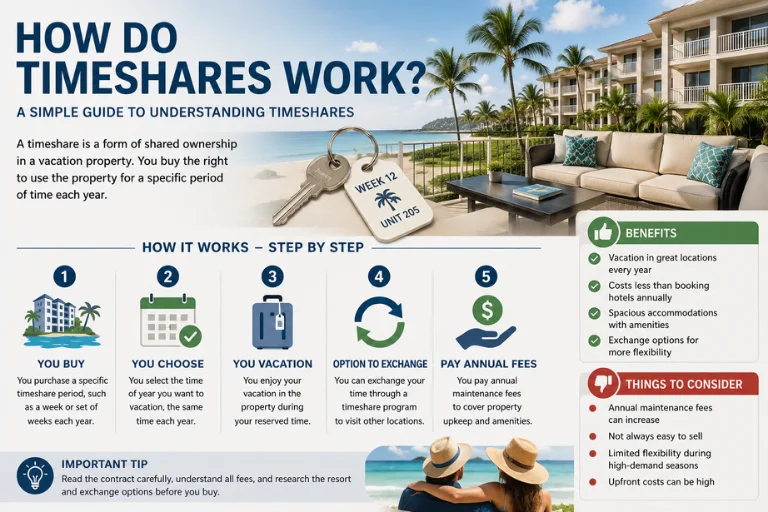
If you searched “how do timeshares work,” the short answer is this: you pay for recurring access to vacation accommodations, usually through a deeded interest or contract-based use rights. Your stay may be tied to a fixed week, a flexible reservation window, or points, and you typically owe annual fees whether you travel or not.
That arrangement can make vacations predictable, but the purchase price is only part of the commitment. Booking rules, maintenance charges, exchange fees, and exit terms can matter as much as the resort itself.
| Key point | What it means |
|---|---|
| Main purpose | Recurring access to vacation accommodations |
| Common booking systems | Fixed week, floating week, or points |
| Ownership structure | Deeded real estate or contract-based use rights |
| 2025 average U.S. sales price | $24,740 per transaction |
| 2025 average maintenance fee | $1,550 per weekly interval |
| If you don’t travel | Annual fees and taxes may still be due |
| Getting out | Cancellation rights vary; resale can be difficult |
ARDA’s 2026 industry report, which covers calendar year 2025, reports the current sales and maintenance-fee averages above. ARDA is the industry trade association, so those figures are useful market benchmarks rather than consumer recommendations.
Key takeaways
- A timeshare is primarily a vacation-use arrangement, not a conventional investment.
- The booking system determines when, where, and how long you can stay.
- Annual maintenance charges can continue even when you don’t use your vacation time.
- Before buying, understand both the cancellation window and the long-term exit process.
What Is a Timeshare?
A timeshare gives you recurring rights to use a vacation property. The Federal Trade Commission’s consumer guidance on timeshares explains that an agreement may provide access to a particular property for a specific period or use a points system covering designated properties. Some arrangements involve an ownership interest in real estate.
Others provide contractual use rights without giving you a deed. That distinction matters if you later want to transfer, inherit, or dispose of the interest. For more general information about property ownership, you can also browse Publishie’s real estate section.
How Do Timeshares Work in Practice?
The first thing to understand is that ownership and booking are separate questions. A contract tells you what legal interest you have, while the reservation system controls how you use your vacation time.
Three scheduling models are common:
- Fixed week: You receive the same week each year, such as the second week of July. It offers predictability but less flexibility.
- Floating week: You request a stay during a defined season or date range. Popular periods may require early booking.
- Points system: You receive a set number of points to spend on eligible stays. The required points can vary based on destination, dates, unit size, and length of stay.
The FTC advises buyers to examine point rules closely. You should know whether unused points expire, what upgrades cost, and whether the dates you want require more points.
Deeded Ownership vs. Right-to-Use Contracts
| Structure | What you receive | Duration |
|---|---|---|
| Deeded | A fractional real-property interest | Often continuing unless transferred |
| Right-to-use | Contractual permission to use accommodations | Usually limited by the contract term |
The FTC states that a deeded interest is considered real property and may pass to heirs. Contract-based arrangements operate differently because the developer can retain ownership of the underlying property. Points don’t automatically tell you which legal structure you have. They may simply be the system used to allocate stays, so read the ownership section of the contract separately.
What Does a Timeshare Cost?
The initial price can be substantial. ARDA reports that the average U.S. transaction price was $24,740 in 2025, while the average maintenance fee was $1,550 per weekly interval. Here’s a useful cost check. If you paid those two current averages and the annual fee never increased, ten years of ownership would total $40,240 before financing interest, travel, taxes, exchange charges, or special assessments.
That is a baseline illustration, not a forecast. The FTC warns that maintenance charges can rise and tells buyers to ask whether a plan has a fee cap. It also says fees and taxes can remain payable even when you don’t use the property. Before comparing the purchase with hotel prices, calculate the full cost per vacation night. Include the purchase price, financing, annual charges, booking fees, and transportation.
Can You Stay at Different Resorts?
Possibly. A points-based program may let you book different properties within its own network. Some ownership programs also participate in separate exchange systems. Flexibility doesn’t mean every resort or date will be available. The FTC recommends checking exchange charges, booking restrictions, and the number of points required for the location, unit, season, and length of stay you want.
If destination flexibility matters to you, compare the arrangement with ordinary trip planning through Publishie’s travel guides. For example, its Italy travel guide shows the type of independent itinerary you could compare against resort-based travel.
Benefits and Drawbacks to Consider
| Potential benefit | Related tradeoff |
|---|---|
| Predictable annual vacation | Long-term recurring charges |
| Apartment-style resort accommodation | Less freedom than booking any hotel |
| Points can offer destination choice | Popular dates may require more points |
| Exchange programs broaden options | Exchange fees or restrictions may apply |
| Familiar property and amenities | Resale or exit may be difficult |
The right balance depends on how you travel. Someone who returns to the same destinations each year may value predictability more than a traveler who frequently changes plans. The financial side deserves equal weight. A vacation product can still be enjoyable even if it has poor resale value, but that means the decision should be based on expected use rather than anticipated appreciation.
Can You Cancel, Sell, or Get Out?

If you recently signed, check the contract immediately for a rescission or cooling-off period. The FTC notes that state law or the contract may determine how long you have to cancel. It recommends following the written cancellation procedure and keeping proof that your notice was sent. Once that period has ended, leaving can become harder.
The FTC recommends contacting the developer or resort management company first to ask about available exit programs before paying a third-party company.
Be cautious of an exit or resale company:
- guarantees a buyer or guaranteed cancellation,
- demands a large payment before doing any work, or
- tells you to stop paying your loan or annual fees.
Those are warning signs identified by the FTC. Selling may also produce much less than the original purchase price, so don’t assume you will recover what you paid.
Are They Worth It?
A vacation ownership arrangement can suit someone who travels consistently, likes resort accommodations, plans ahead, and can comfortably absorb recurring charges. It is a weaker fit if you rarely vacation, need maximum destination flexibility, dislike advance booking, or expect the purchase to grow in value. The FTC specifically advises consumers to view the value as vacation use rather than an investment.
A useful decision test is simple: compare ten years of realistic ownership costs with ten years of the trips you would otherwise book. Then judge the difference based on both money and convenience.
What to Check Before You Sign
Don’t make the decision from the sales presentation alone. Take the documents away and compare the contract with the trips you genuinely expect to take. Before committing, calculate a multi-year cost, review the maintenance fee history, test booking availability, get exchange charges in writing, locate the rescission instructions, and ask what happens if you want to leave.
A timeshare can provide predictable vacations, but only when its costs and rules match how you already travel. If the numbers or exit terms are unclear, have an independent attorney or financial professional review the agreement before you sign.
Frequently Asked Questions
Your options depend on the program. Points may work across several affiliated properties, while an exchange program may let you trade your week or points for another destination. Extra charges, availability limits, and different point requirements can apply.
Generally, yes. The FTC states that owners may still owe applicable fees and taxes even when they don’t use their vacation time.
Only certain arrangements create a deeded real property interest. Other contracts give you use rights without transferring ownership of the underlying real estate.
You may have a rescission period under applicable state law or your contract. Check the documents immediately, as the deadline and required cancellation method may vary.